Svitava river industrial educational trail
Löw-Zwicker / Aryanization of Jewish property
-
Sedmé zastavení industriální stezky u řeky Svitavy
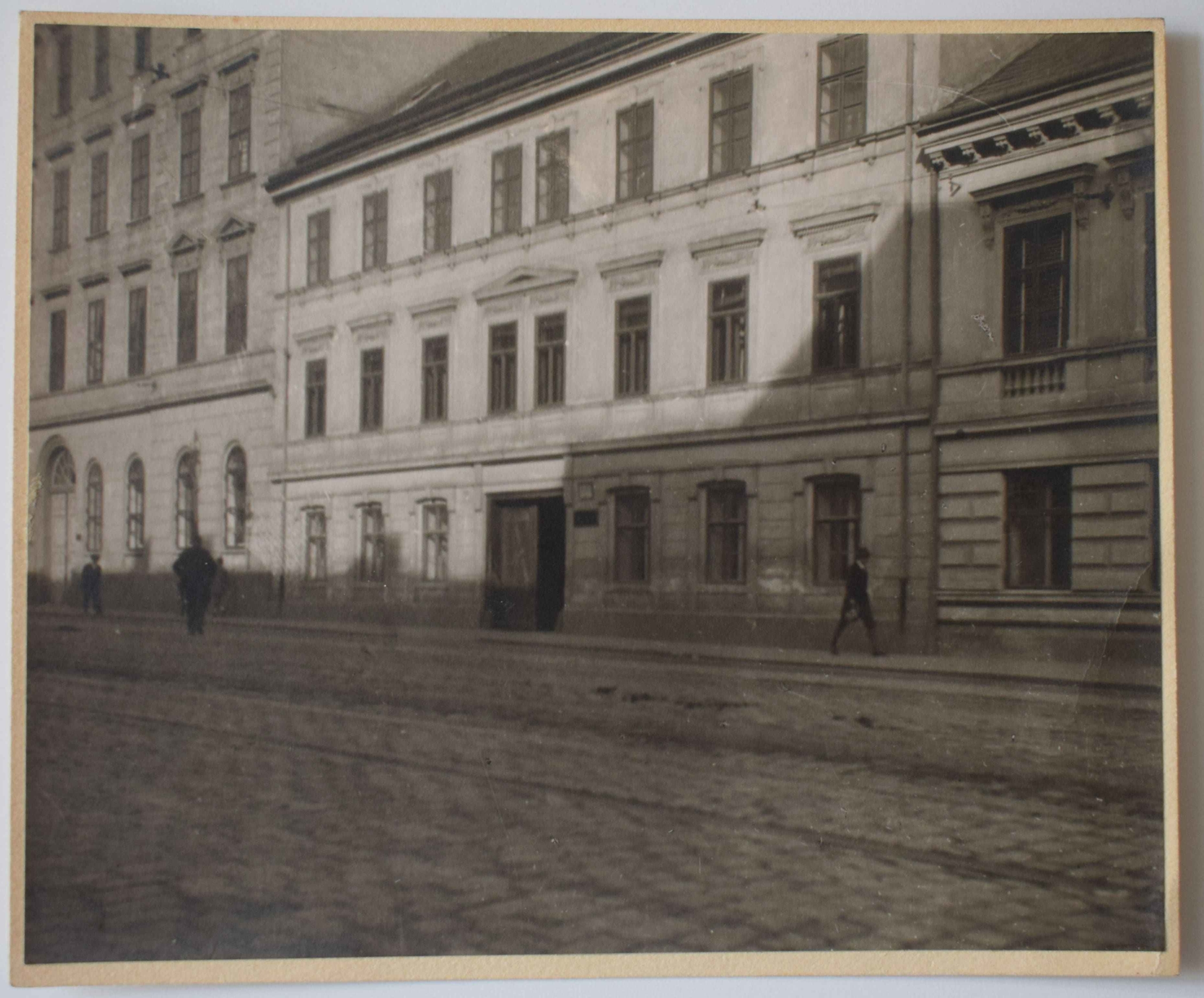
On a triangular plot of land between Cejl Street and the Svitava River, former textile factory complex, founded by Adolf Löw in the second half of the 19th century, can be seen. Like most of the Jewish entrepreneurs first generation members, Adolf Löw came from a poor family from the region of Vysočina. He trained as a weaver and, upon founding his own weaving mill, became one of Austria-Hungary’s most prominent entrepreneurs, alongside his brother-in-law Bedřich Schmal. Löw gradually moved the textile production to Vysočina, (Velký Beranov and Helenín), where he later passed it on to his equally successful son, Karel. In 1900 he sold the buildings on Cejl Street to the company Himmelreich & Zwicker, which continued with the textile production.
From the mid-19th century onwards, most textile companies were owned by Jewish businessmen, coming from poor families with a tradition of single loom textile production or textile goods trade. Within one or two generations, these “self-made men” managed to build their own factory empires extending far beyond the borders of Austria-Hungary or its successor, Czechoslovakia. During the First Republic, most Jewish entrepreneurs claimed German nationality, using German as their main language as well.
During the politically turbulent 1930s and with the rise of Nazism in Germany, those with greater political foresight began to look for a way out of the threatened Europe. Although some succeeded, most of them stayed in Czechoslovakia, taking the full brunt of the so-called Nuremberg Laws after the creation of the Protectorate of Bohemia and Moravia. These laws, applied in Germany since 1 January 1938, forced Jews out of both business and manufacturing as well as offering any commercial services, providing the basis for the so-called Aryanization of businesses across Germany. In practice, this meant placing a forced administrator in Jewish-owned businesses, free to either make the entrusted enterprise go bankrupt, or to sell it for very cheap, usually to himself. The original Jewish owners got cast out from both their businesses and houses or apartments, being moved into formerly working-class balcony access houses in the area of Cejl, Francouzská and Bratislavská Streets, from where they were subsequently transported to concentration camps.
After the end of the Second World War, the formerly Jewish, now Aryanized companies were confiscated as German property by a presidential decree. The original owners – in case they managed to survive the Holocaust – claimed their property to be returned, but usually failed to settle the restitution until 1948. After the communist coup, restitutions were off the table with zero follow-up from that point on. As a result, most of the Brno textile mills were merged into the Vlněna and Mosilana factories.
Similar places nearby
-
Moritz Fuhrmann – The Löw-Beer Villa
Moritz Fuhrmann’s plush and faux fur (so-called krymr) factory was founded at 72 Cejl Street in 1872, however, Fuhrmann only bought it in 1895.
-
Mitop / The textile production demise phenomenon
In 1890, the Austrian Felt Mills Joint Stock Company was co-founded by B. Engel & Co., Adolf Löw & Son and Seidl & Jellinek.